


What is the half-life of a drug?
Half-life is a pharmacokinetic parameter that refers to the time it takes for the concentration of a drug in the body to decrease to half of its original amount after administration.¹ ² It directly correlates to the duration of the therapeutic effect of a medicine.
It is important in practice as it helps health professionals to determine appropriate dosing intervals, estimate the time needed to reach steady-state blood levels, and understand how long a drug will remain in the body.
In this article, we will explain what a half-life is and its role in pharmacokinetics. We will also look at the importance of the concept in relation to medicines used in mental health and where to find information on the half-life of individual drugs.
Please complete the form at the bottom of this article to request a complimentary trial of MedicinesComplete.
What does half-life mean in medical science?
The term half-life (symbol t½) refers to the elimination half-life. This is defined as the time it takes for the concentration of a drug in the body to decrease by 50%. After one half-life has passed, half of the initial amount has been eliminated from the body. The half-life is specific to individual drugs.¹
Half-life is critical in pharmacokinetics. Pharmacokinetics is the study of how a drug moves through the body; how it is absorbed, distributed, metabolised, and excreted (ADME).² A good understanding of these pharmacokinetic principles is fundamental to prescribing. It supports health professionals in prescribing medicines that will provide the greatest benefit at the lowest risk and helps them to individualise and adjust treatment as necessary, given the varied physiology and lifestyles of patients.²
While all ADME processes influence a drug’s half-life, volume of distribution and excretion are the most relevant.³
Distribution is the process by which medication is dispersed throughout the body to reach its target site of action.¹ The volume of distribution (Vd) reflects the extent of drug distribution; it is influenced by several factors including the physicochemical properties of the drug, such as protein binding, as well as physiological factors, such as blood flow, age and sex, and conditions such as renal impairment and heart failure.
Excretion refers to how and where a drug, or its metabolites, is eliminated from the body. Clearance (Cl) is the measure for how efficiently a drug is excreted over time. It is often related to the patient’s body size as well as whether the drug is water-soluble (i.e. generally cleared by excretion into the urine) or lipid-soluble (i.e. often requiring metabolism to water-soluble metabolites by the liver before excretion). Clearance is therefore affected by a range of factors, including age, renal or hepatic disease and drug interactions.²
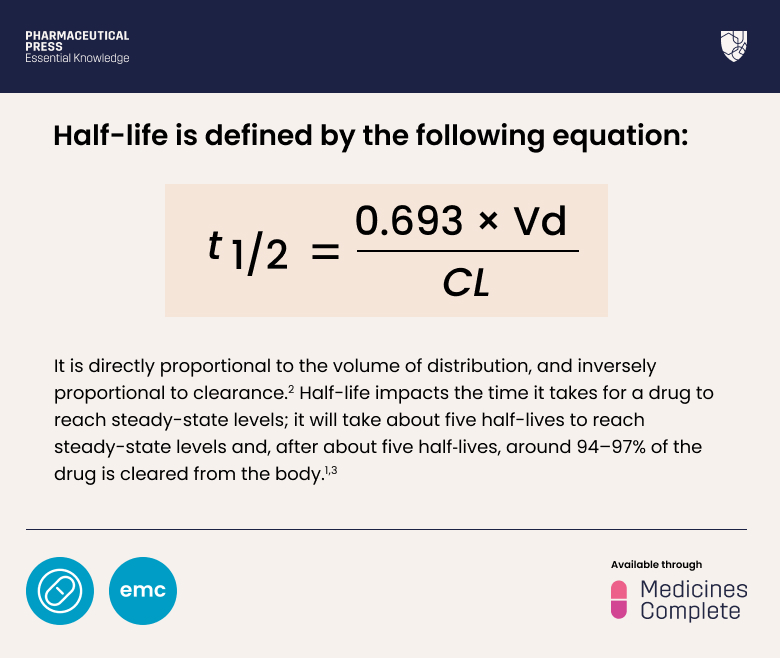
Half-life is defined by the equation t½=(0.693 x Vd)/Cl.
Why is the half-life of a drug important?
As discussed, drug half-life is a complex parameter. Health professionals need to know not only the half-life of prescribed drugs but also the patient factors that might affect it. These include age, genetics, and concurrent disease.³ A good understanding of these factors allows health professionals to optimise drug therapy for individual patients, ensuring efficacy while minimising adverse effects. For example, gentamicin, which is cleared by renal excretion, has a half-life of two to three hours in an adult with normal renal function but this can be 24 hours or more in a patient with severe renal impairment.
A medicine’s half-life directly influences how often it should be taken, how quickly it starts to work and how long side effects may last. Drugs with a short half-life, such as paracetamol, will leave the body quickly, so patients need to take them frequently. For drug classes that are associated with withdrawal or discontinuation syndromes, this is more likely to occur with short half-life drugs.³
Short half-life medicines can be formulated as modified or controlled-release preparations to extend their half-life. More sophisticated approaches are now being used to extend the half-life of biologic medicines to address the challenges of frequent dosing and fluctuations in blood levels.⁴ Techniques being explored include chemical conjugation and microsphere delivery systems.⁴
Drugs with a long half-life stay in the body longer and have a longer duration of action allowing for less frequent dosing, but also have an increased risk of accumulation and toxicity if not managed carefully.³ Amiodarone is a notable example of a long half-life drug. It has an elimination half-life of about 50 days on average due to its extensive tissue distribution.⁵ It has potential adverse effects on several body systems including the eyes, lungs, thyroid, skin and liver; these side effects can persist months after stopping treatment.
The importance of half-life for mental health medications.
Mental health medicines are widely prescribed, with around one in six adults in the UK receiving treatments including antipsychotics, antidepressants, and anti-anxiety medication. Patients often need to switch medicines and have their treatment regimens adjusted. Knowledge of a medicine’s half-life can be particularly helpful in these situations.
Psychotropic medications with short half-lives, that are therefore rapidly eliminated from the body after stopping treatment, are more likely to be associated with withdrawal symptoms and drug discontinuation syndromes.³ Short-acting benzodiazepines, such as alprazolam and lorazepam, for example, are more problematic to discontinue than long-acting benzodiazepines, such as diazepam and clonazepam.³
Psychotropic medicines with long half-lives, such as fluoxetine or aripiprazole, require careful management due to their prolonged duration in the body. While they require less frequent dosing, this can also delay the onset of therapeutic effects, complicate switching between medicines when required, and increase the risk of drug accumulation. A medicine’s half-life can also be important in the context of side effects; sedating psychotropics such as olanzapine are best administered at night, but blood levels may still be high the next morning, leading to grogginess or hangover-type symptoms.³
Where can you find information about the half-life of a drug?
Health professionals can find information on the half-life of individual drugs in the pharmacokinetics sections of Martindale: The Complete Drug Reference or the Summary of Product Characteristics found on Electronic Medicines Compendium (emc), available through MedicinesComplete.
Specialist resources such as Critical Illness and Psychotropic Drug Directory also have valuable information on pharmacokinetics to guide dosing in these care settings. Psychotropic Drug Directory has easy to use reference tables on pharmacokinetics of antidepressants and antipsychotics, including half-life. Critical Illness has detailed information on the pharmacokinetics of the drugs most commonly used in critically ill patients.
Trial form
Please complete the form below to request a complimentary trial to knowledge products through MedicinesComplete.
References
1. Hallare, J., Gerriets, V. (2025). Half-life. In StatPearls [Internet]. StatPearls Publishing. Elimination Half-Life of Drugs – StatPearls – NCBI Bookshelf (Accessed: 11 August 2026).
2. Grogan, S., Preuss, C. V. (2023). Pharmacokinetics. In StatPearls [Internet]. StatPearls Publishing. Pharmacokinetics – StatPearls – NCBI Bookshelf (Accessed: 11 August 2026).
3. Andrade, C. (2022). The practical importance of half-life in psychopharmacology. The Journal of Clinical Psychiatry, 83(4), 41940.
4. Wang Y, Chang J, Liu J. Molecular engineering approaches to half-life extension of therapeutic biomolecules. Front Pharmacol. 2026 Apr 10;17:1778569. doi: 10.3389/fphar.2026.1778569. PMID: 42038289; PMCID: PMC13106320.
5. MedicinesComplete, Martindale: The Complete Drug Reference, Drug: Amiodarone [www.medicinescomplete.com] (Accessed: 11 August 2026).